Scenarios
Practice one moment until it’s yours
Each GTS scenario is a focused rehearsal with clear objectives, a lesson plan in the headset, and three difficulty levels. Start where it’s easy, then raise the stakes.
Three levels
Difficulty levels
Level 1
Easy A willing room
Students are new, a little nervous and willing. Routines stick on the first or second try, side talk is rare and stops at your signal, and one student asks a curious (not rude) question about how strict you will be.
Your focus: Get the moves in order: welcome, names, agreements, one routine practiced for real.
Level 2
Normal A real Monday
Students test the edges. The boundary question comes twice, a side conversation starts during introductions, someone asks to use the restroom mid-activity, and the attention signal needs a second practice before it works.
Your focus: Hold warmth and expectations at the same time; redirect privately and keep the lesson moving.
Level 3
Hard Prove it
Students push back on why rules exist at all, two students keep side-talking until they are redirected privately, the quiet student will not answer the first time, and the attention signal only works once it has been practiced several times.
Your focus: Explain the why behind every agreement, repair quickly, and never trade dignity for compliance.
Available now
First Day of School: the first 15 minutes
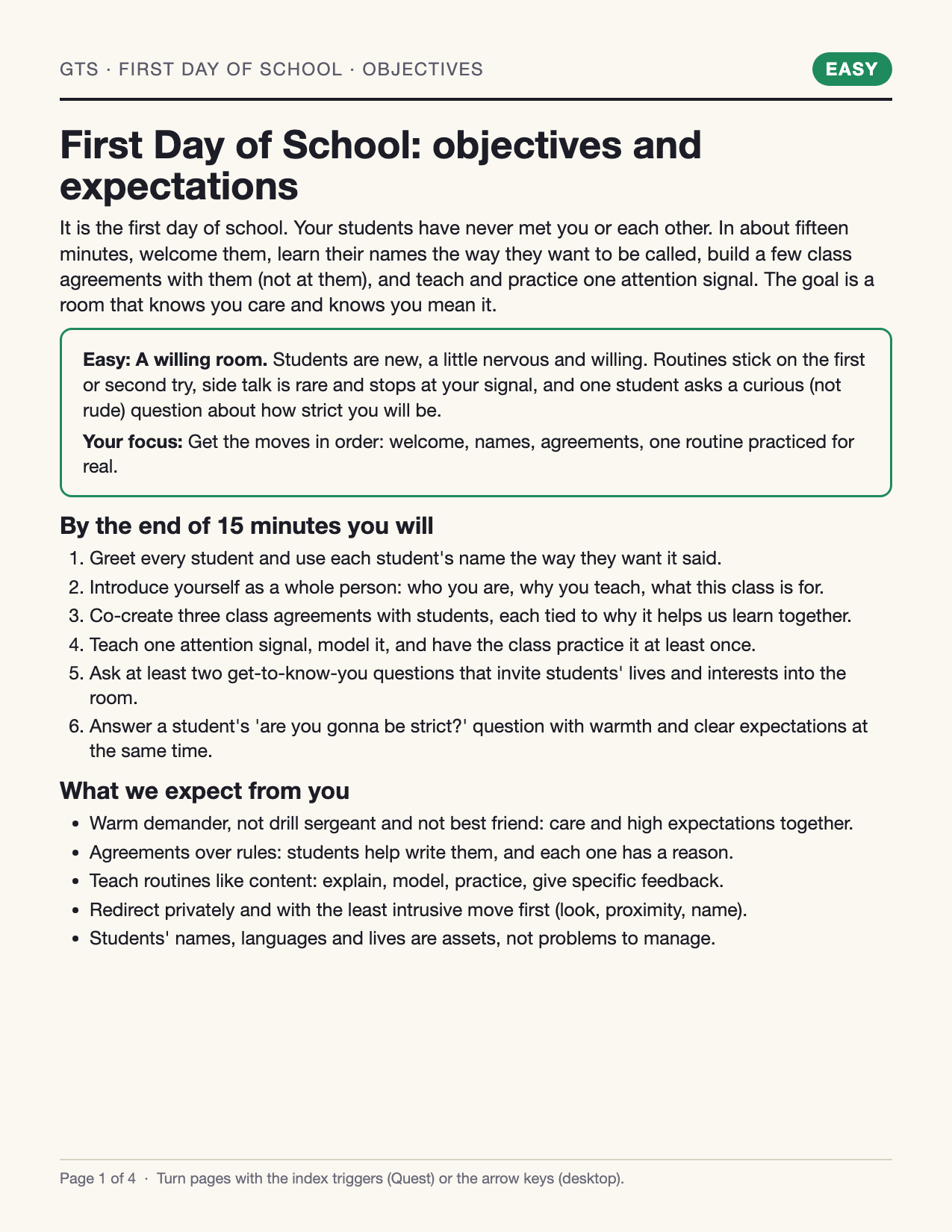
It is the first day of school. Your students have never met you or each other. In about fifteen minutes, welcome them, learn their names the way they want to be called, build a few class agreements with them (not at them), and teach and practice one attention signal. The goal is a room that knows you care and knows you mean it.
15 minutesScene 2 (spacious classroom) · Scene 3 (Leroy, Denise, June)Easy · Normal · Hard
Objectives
- Greet every student and use each student's name the way they want it said.
- Introduce yourself as a whole person: who you are, why you teach, what this class is for.
- Co-create three class agreements with students, each tied to why it helps us learn together.
- Teach one attention signal, model it, and have the class practice it at least once.
- Ask at least two get-to-know-you questions that invite students' lives and interests into the room.
- Answer a student's 'are you gonna be strict?' question with warmth and clear expectations at the same time.
What we expect from you
- Warm demander, not drill sergeant and not best friend: care and high expectations together.
- Agreements over rules: students help write them, and each one has a reason.
- Teach routines like content: explain, model, practice, give specific feedback.
- Redirect privately and with the least intrusive move first (look, proximity, name).
- Students' names, languages and lives are assets, not problems to manage.
Look-fors
- Uses student names (and preferred names) during the lesson
- Asks students what they need from a class and from a teacher
- Ties each agreement to learning, safety or respect
- Practices the attention signal and acknowledges the class when it works
- Speaks to a student privately or by name before any public correction
In the headset
The built-in lesson plan
Open it any time with Y on Quest or L on desktop. It opens to these four pages: objectives, a simple plan, attention getters, and a guide to building the room.
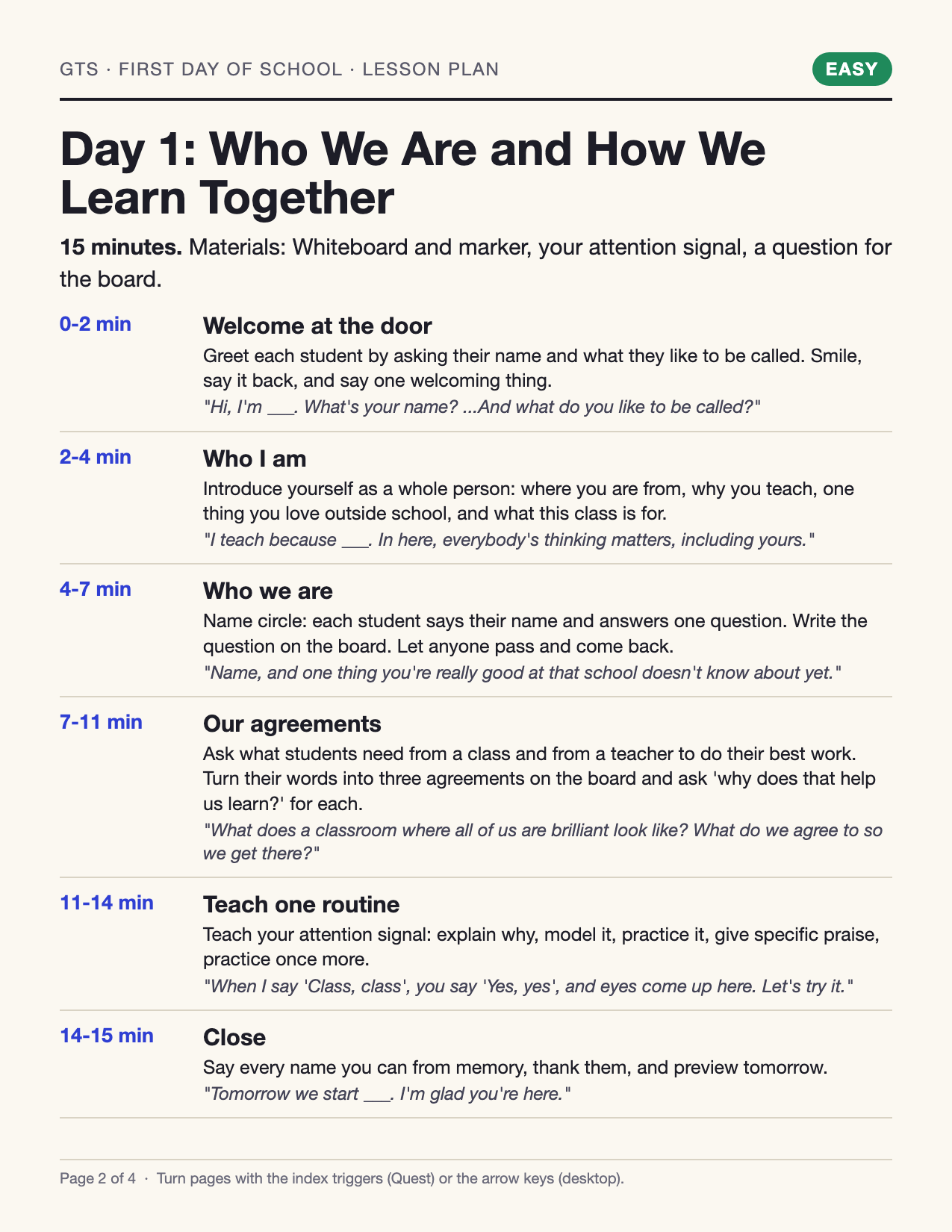
Day 1: Who We Are and How We Learn Together
- 0-2 minWelcome at the door. Greet each student by asking their name and what they like to be called. Smile, say it back, and say one welcoming thing.
- 2-4 minWho I am. Introduce yourself as a whole person: where you are from, why you teach, one thing you love outside school, and what this class is for.
- 4-7 minWho we are. Name circle: each student says their name and answers one question. Write the question on the board. Let anyone pass and come back.
- 7-11 minOur agreements. Ask what students need from a class and from a teacher to do their best work. Turn their words into three agreements on the board and ask 'why does that help us learn?' for each.
- 11-14 minTeach one routine. Teach your attention signal: explain why, model it, practice it, give specific praise, practice once more.
- 14-15 minClose. Say every name you can from memory, thank them, and preview tomorrow.
Attention getters
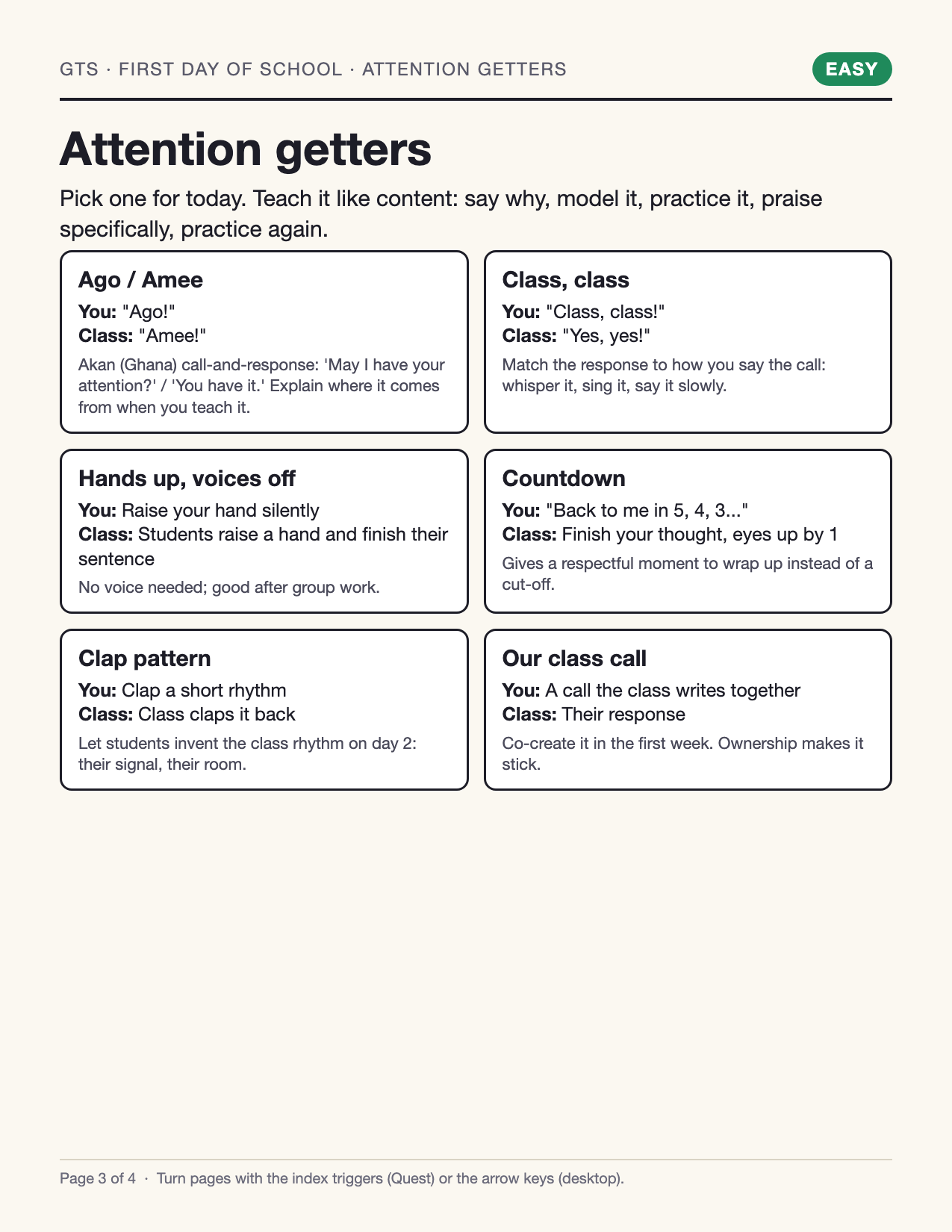
- Ago / Amee — "Ago!" / "Amee!". Akan (Ghana) call-and-response: 'May I have your attention?' / 'You have it.' Explain where it comes from when you teach it.
- Class, class — "Class, class!" / "Yes, yes!". Match the response to how you say the call: whisper it, sing it, say it slowly.
- Hands up, voices off — Raise your hand silently / Students raise a hand and finish their sentence. No voice needed; good after group work.
- Countdown — "Back to me in 5, 4, 3..." / Finish your thought, eyes up by 1. Gives a respectful moment to wrap up instead of a cut-off.
- Clap pattern — Clap a short rhythm / Class claps it back. Let students invent the class rhythm on day 2: their signal, their room.
- Our class call — A call the class writes together / Their response. Co-create it in the first week. Ownership makes it stick.
The guide
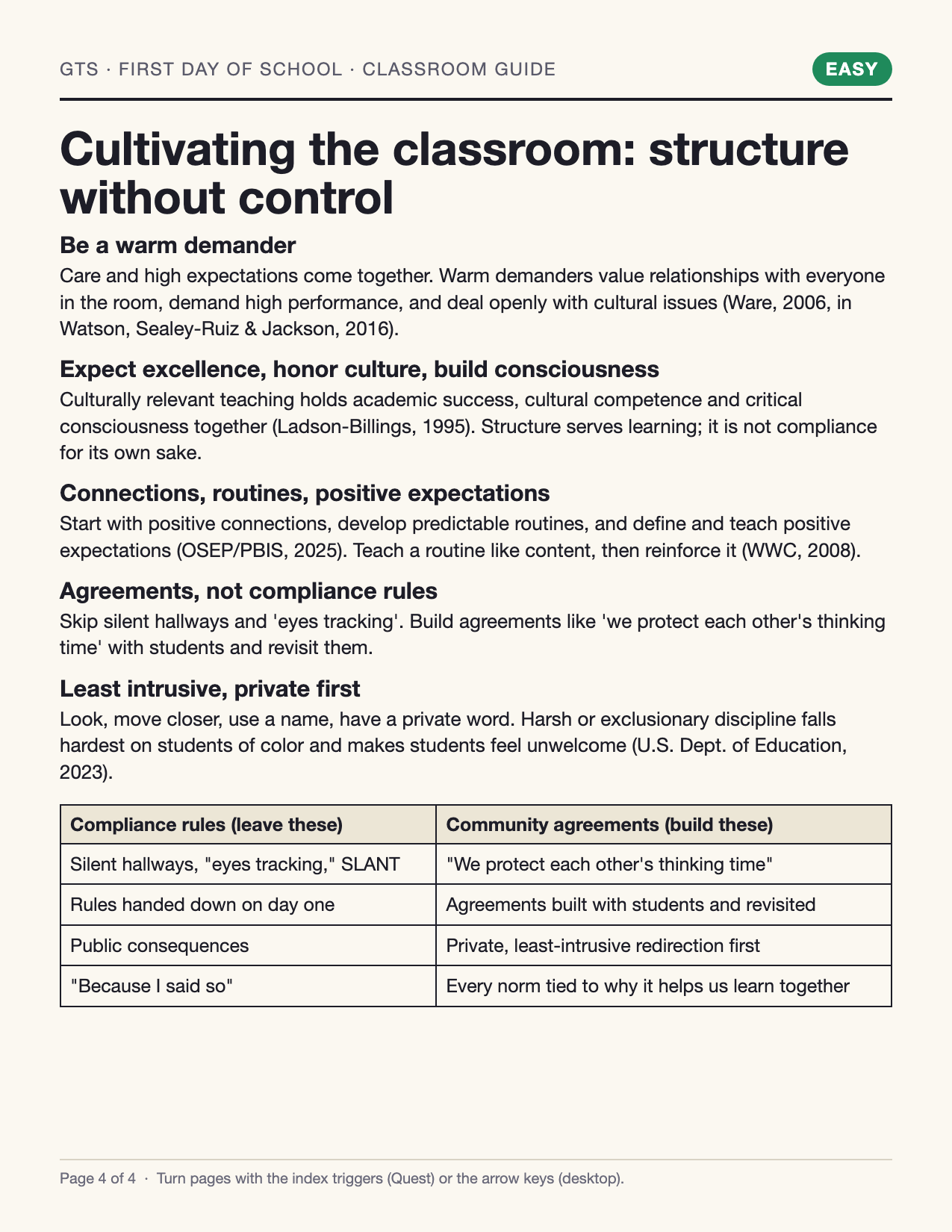
Cultivating the classroom: structure without control
- Be a warm demander. Care and high expectations come together. Warm demanders value relationships with everyone in the room, demand high performance, and deal openly with cultural issues (Ware, 2006, in Watson, Sealey-Ruiz & Jackson, 2016).
- Expect excellence, honor culture, build consciousness. Culturally relevant teaching holds academic success, cultural competence and critical consciousness together (Ladson-Billings, 1995). Structure serves learning; it is not compliance for its own sake.
- Connections, routines, positive expectations. Start with positive connections, develop predictable routines, and define and teach positive expectations (OSEP/PBIS, 2025). Teach a routine like content, then reinforce it (WWC, 2008).
- Agreements, not compliance rules. Skip silent hallways and 'eyes tracking'. Build agreements like 'we protect each other's thinking time' with students and revisit them.
- Least intrusive, private first. Look, move closer, use a name, have a private word. Harsh or exclusionary discipline falls hardest on students of color and makes students feel unwelcome (U.S. Dept. of Education, 2023).
Coming next
Scenarios in development
In development
Redirecting talkative students
Friends whisper while you teach. Practice the least-intrusive ladder: a look, moving closer, a name, a private word, and a check-in after, without stopping the lesson.
In development
The student who keeps getting up
The reason changes every run: a pencil, a need to move, avoiding the work, or something upsetting. Practice asking before assuming, and offering a legitimate way to move.